
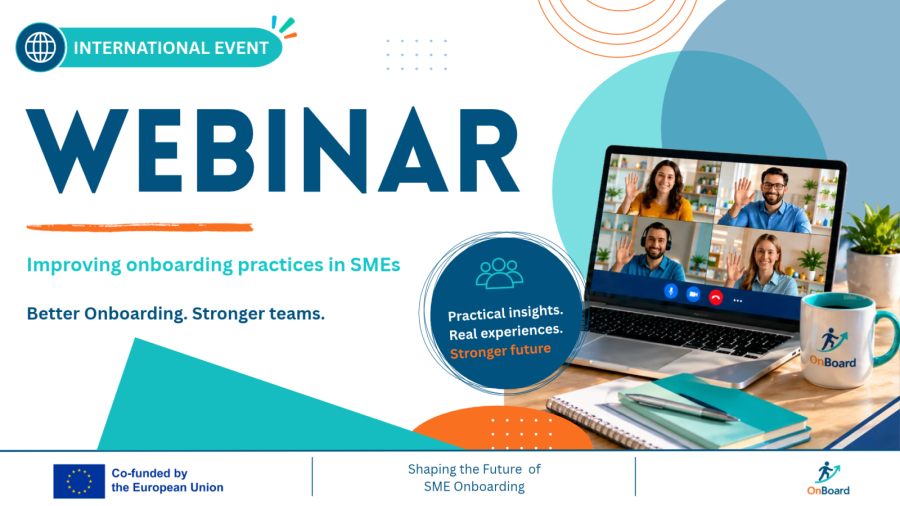
On 13 May 2026, the OnBoard project organised the international webinar “Improving Onboarding Practices in SMEs”, bringing together project partners, researchers and professionals to discuss how small and medium-sized enterprises can create more effective, structured and people-centred onboarding processes.
The 90-minute online event combined the main findings of the OnBoard transnational research with practical perspectives from vocational education and training, HR, entrepreneurship and employees. The webinar explored the challenges SMEs face when integrating new employees and highlighted practical approaches that can improve retention, engagement and long-term business resilience.
Research findings: onboarding in SMEs remains largely informal
A central part of the webinar was dedicated to the findings of the OnBoard research on onboarding practices across several European countries.
The results showed that onboarding in many SMEs remains largely informal and dependent on individual managers or colleagues. New employees are often expected to learn by doing, with limited structure and inconsistent guidance.
Key research message: successful onboarding depends strongly on mentoring, clear expectations and regular communication. Having a designated mentor or contact person was identified as one of the most important elements of successful onboarding.
Another key issue was the gap between what new employees expect and what they actually experience. While employees often expect a structured, supportive and well-organised introduction to their role, the reality can involve fragmented information and limited guidance.
From research to practical HR approaches
The webinar moved from research findings to practical approaches that SMEs can apply in their own organisations.
A simple and consistent onboarding plan from the first days.
A clearly assigned person who can guide and assist the new employee.
Clear expectations, roles and responsibilities from the beginning.
Building trust, belonging and strong human relationships.
The importance of leadership was also emphasised. Onboarding should not be treated only as an administrative HR responsibility, but as a process supported by managers and company leadership.
Digital tools and AI can help organise information, automate certain steps and personalise onboarding activities. However, the discussion stressed that technology should support rather than replace human interaction, mentoring and trust.
Inclusion, skills development and the employee perspective
The webinar also addressed onboarding from entrepreneurial and workers’ perspectives.
The entrepreneurial contribution focused on inclusion, trust, mentorship and multicultural integration, presenting onboarding as part of a wider ecosystem that can help employees adapt both to the organisation and to their broader professional environment.
From the workers’ perspective, the discussion highlighted challenges such as limited mentoring and training, skills mismatches, employment uncertainty and differences between employee expectations and the capacities of SMEs. Particular attention was given to the role of mentoring, skills development and quality of employment in supporting successful integration.
Strong international participation
The highest numbers of registrations came from Slovenia, Italy, Bulgaria, Spain and Denmark. Participation during the event was also strong, with a median attendance duration of 82 minutes.
Participant feedback was highly positive, while speaker contributions and event organisation received particularly strong evaluations. Interest in future OnBoard activities was also high.
The next steps for OnBoard
The webinar represents an important step in transforming the project’s research findings into practical solutions.
Based on the identified needs of SMEs and employees, OnBoard is developing a range of resources, including a structured training programme, online learning opportunities, resources for VET providers and digital tools to support onboarding, retention and employee integration.
Effective onboarding does not have to be complex or expensive. It requires structure, communication, mentoring and genuine attention to the employee experience from the very beginning.
By bringing together research evidence and practical perspectives from across Europe, the webinar provided an important foundation for the next stages of the OnBoard project and its work towards stronger, more resilient and people-centred SMEs.